Understanding Load and Capacity
One concept I talk a lot about with patients is the load-capacity framework for explaining how injuries and pain happen. Simply put, injuries occur when a load placed upon the body is greater than the body’s capacity to tolerate that load. Load is any kind of stress or physical demand placed on the body, such as lifting weights, or going for a run, or even painting. Capacity is how much stress your tissues can handle at that moment.
One concept I talk a lot about with patients is the load-capacity framework for explaining how injuries and pain happen. Simply put, injuries occur when a load placed upon the body is greater than the body’s capacity to tolerate that load. Load is any kind of stress or physical demand placed on the body, such as lifting weights, or going for a run, or even painting. Capacity is how much stress your tissues can handle at that moment.
From an acute injury standpoint, this framework makes sense, but even then, many factors influence both load and capacity. When we talk about pain though, things get a bit trickier. Pain is real, but it’s also a very individual experience, and it doesn’t always line up perfectly with what’s happening in the tissues. Load and capacity may still play a role, but they’re just one part of the picture.
Still, the framework is useful, so here are a few examples that help make it clearer:
Rolling your ankle:
You’re out for a run when you hit a divot and you roll your ankle inwards- a classic ankle sprain. In that one moment, the ligaments on the outside of your ankle were suddenly exposed to a large load and were stretched beyond their capacity. This is an example of an acute injury where the load spikes and exceeds what the tissue can handle.
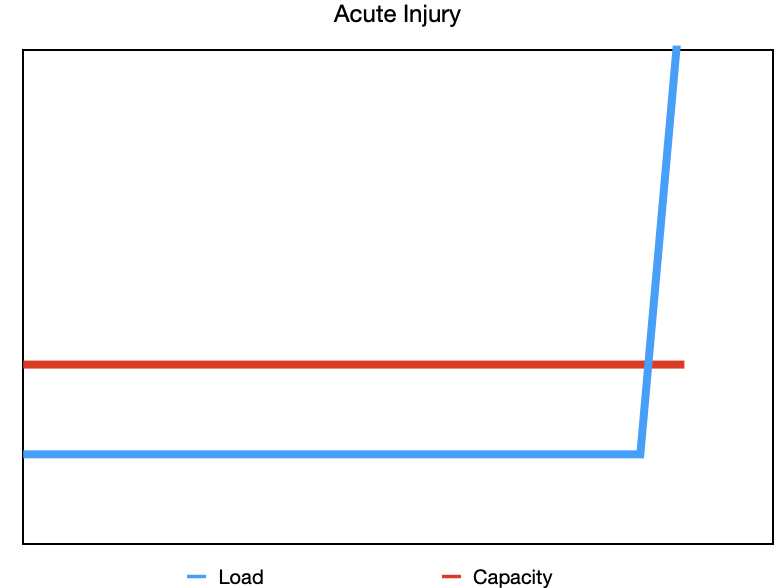
Acute injury- a one-time quick exposure to a large load that causes tissues injury.
Increasing training too quickly:
Let’s say your run doesn’t have any surprises, and you’ve been progressing nicely, adding a little distance each week. You’re feeling good, so instead of the planned 500m increase, you bump it up by 1km. And the next week, you do the same. Now you’re noticing your Achilles tendon is sore and walking is uncomfortable. You didn’t tear your Achilles, but you increased your running (the load) at a faster rate than your body was adapting (your capacity). That’s a chronic overload issue and more of a sensitivity response than an actual tissue injury.
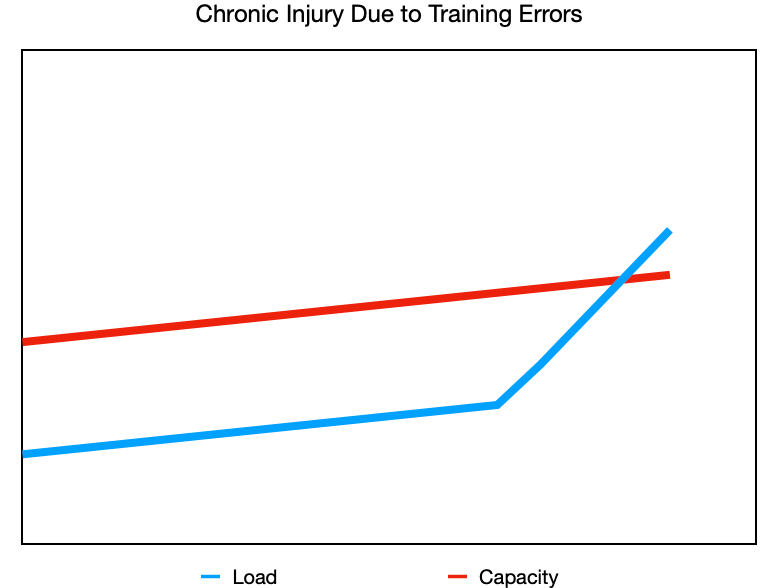
Injury due to training errors- making increases in your training (intensity, frequency, duration) faster than what your tissues can adapt to.
Repetitive or unaccustomed activity:
Now you’re finally getting around to painting your living room after putting it off for weeks. You want to get both coats done this weekend, so you spend long days painting. As you work, your forearm and elbow start to get more and more sore. Painting isn’t “hard,” but it’s repetitive and not something you normally do, putting a repetitive load on your forearm muscles. This is an example of a chronic injury due to repetitive activity but also a new or unaccustomed activity. Because your tissues weren’t used to that specific load, their capacity for it was low, and by the end of the weekend you’re feeling it.
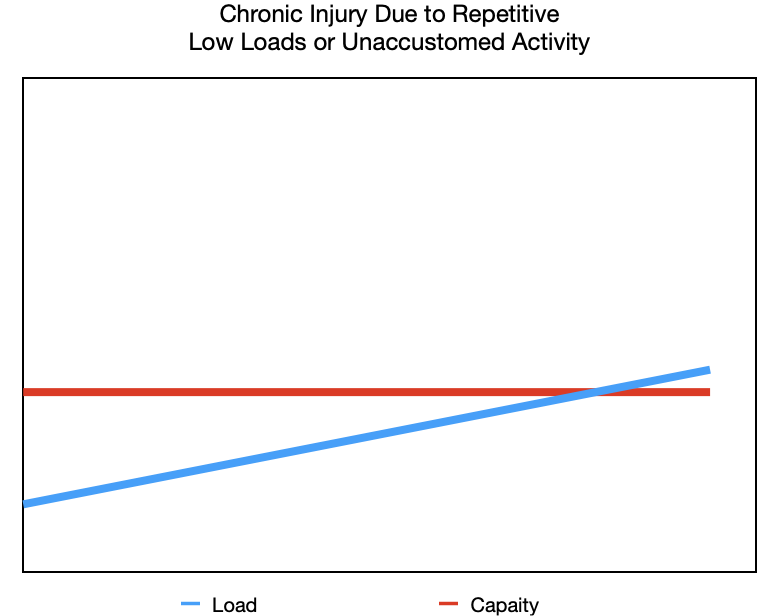
Low load repetition- repeated actions over a long period of time.
Unaccustomed activity- exposing yourself to loads you are not used to.
When capacity drops:
These are all examples of when load increases beyond our capacity, but what about when the load stays the same and capacity changes? You’re still running and following your plan perfectly, but life is chaotic—work is busy, the kids have a million activities, your sleep is off, and you’re skipping breakfast as you race out the door. You’re tired but you’re getting your runs in and now your knee starts hurting. Even though your running hasn’t changed, your capacity has. The load didn’t increase, but your capacity dropped because everything else in life is impacting your recovery.
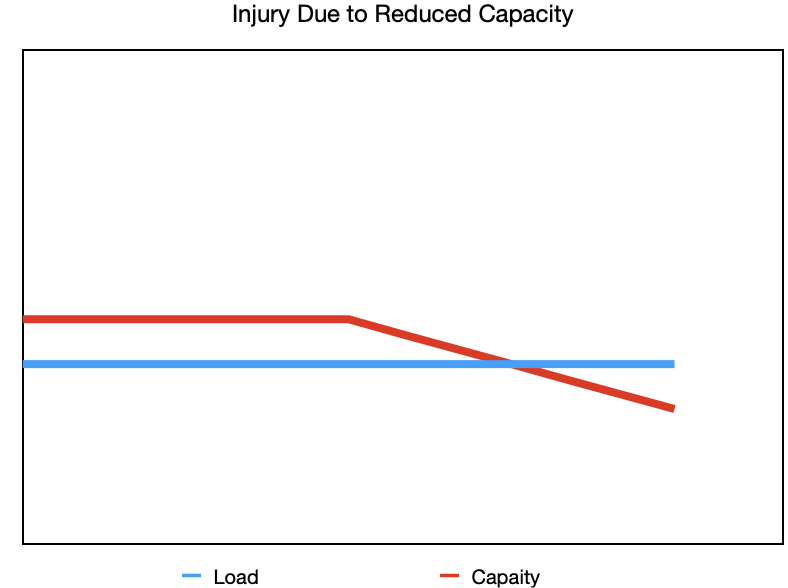
Reduced capacity- the load remains the same, but your ability to tolerate it is lowered.
In all of these scenarios, the relationship between load and capacity is a big part of what’s going on. Injuries and pain are often a web of different factors that culminate in the load being greater than our capacity. Acute injuries are frustrating because sometimes they are just bad luck. Chronic injuries can build up slowly without one clear moment you can point to. The good news is that if you pay attention to the little niggles early on, small adjustments to your training or routine are often enough to calm things down before they turn into something bigger.
Pain and injury rarely come down to one single cause, but understanding how load and capacity interact helps you make informed choices about your training and daily life. By adjusting what you can control and supporting your overall wellbeing, you can keep moving towards the activities you love with more confidence and less frustration.
*Adapted from a similar blog article I wrote in 2023 for Elite Sports Medicine and Conditioning.