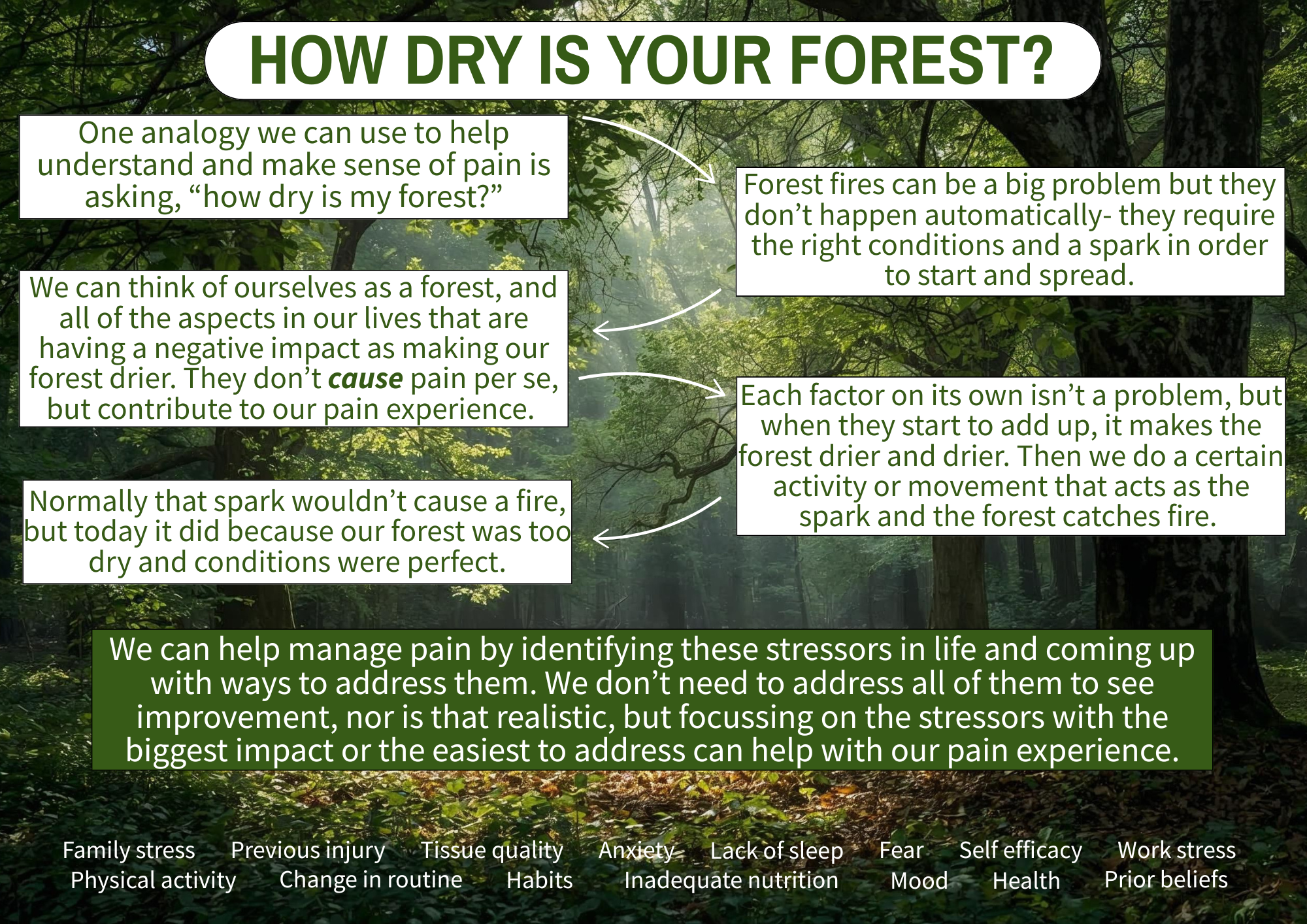
How Dry Is Your Forest? Understanding Why Pain and Injuries Happen
When explaining why injuries occur, I often refer to the Biopsychosocial Model of pain (BPS). The BPS is a holistic model suggesting that health and well-being result from the interconnection and interaction between biological, psychological, and social factors, rather than a single cause.
But the BPS can be misunderstood by both patients and therapists. BPS doesn’t explain injury, but rather just considers multiple factors as opposed to specific causes. Some assume everything has to be perfectly balanced to remain injury-free. There are two problems with this: first, it’s impossible to have every aspect of life going perfectly at once, and second, it treats any single “off” factor as the cause of injury. One common argument against BPS is the incorrect interpretation that “it’s all in your head.” While this argument only factors in the psychological component, it’s generally meant that the physical factors, like movement, technique, biomechanics, and load, are ignored.
One analogy I really like that helps better explain BPS is asking yourself, “how dry is your forest?” This analogy comes from Ben Cormack, who suggests that many factors can make the forest dry, which then only requires a small spark to trigger a fire (i.e. pain). Greg Lehman has a similar analogy, asking how healthy is your ecosystem?
Think of yourself when you’re completely healthy as a nice, lush, green forest. Forest fires (pain and injury) are a problem, but they don’t occur automatically. Rather, they require the right conditions to start and spread. The factors under the three realms of the BPS can all individually make our forest drier; the degree to which they impact your forest will vary.
Biological factors include training volume, previous injury, nutrition, and sleep. Psychological factors include self-efficacy, confidence, mood, and anxiety. Social factors include work and family stress, habits, routines, and social support.
None of these factors cause pain, and each on its own is not a problem, but when they add up, they make our forest drier and drier. A lush forest would need a very big spark in order to start a fire, but a dry forest would only need a small spark.
This may explain the confusion people have when they feel they are doing everything right but still suffer an injury. “I only ran an extra 2km this week, and now my knee hurts.” In a lush forest, that 2km spark would not have been enough to start a fire, but in a dry forest, it was the perfect condition. Being stressed at work and not sleeping as well didn’t cause the pain, but they contributed to that 2km jump in training volume being more than what your body could tolerate.

The good news is that we don’t need to tackle all of the factors in order to see improvements in pain (nor is that realistic). Often, focusing on the stressors with the biggest impact or the easiest to change is enough. Taking the approach of “how can I be healthier” can also help as it will usually tackle several factors at once. But remember, these factors did not cause your injury but rather predisposed you or made an injury more likely. Sometimes the best course is to just acknowledge what has made our forest dry and to do our best to avoid a spark when our forest is dry.
The goal isn’t to find a single cause of pain. The goal is to understand what has dried out your forest, reduce a few key risk factors, and gradually rebuild capacity again.